Labas from Vilnius! Often overshadowed by Riga and Tallinn, Vilnius is one of the Baltics’ most surprising and underrated capitals. With its UNESCO-listed Old Town, beautiful Baroque churches, peaceful gardens and creative neighbourhoods, the city feels both historic and wonderfully alive.
I’ve now visited Vilnius three times, in December, spring and summer, and each time I’ve discovered something new. From Christmas markets and hidden courtyards to incredible restaurants, unexpected Italian influences and the quirky Republic of Užupis, Vilnius is full of surprises.
Easy to explore on foot, full of history, excellent food and plenty of hidden gems, Vilnius deserves a spot on your Europe itinerary. Here are some of my favourite things to see, do, eat and experience in Lithuania’s capital!


Things to do in Vilnius
Vilnius is a wonderfully walkable city, and most of the historic centre can easily be explored on foot. Its Historic Centre is a fascinating mix of Gothic, Renaissance, Baroque and Classical architecture. It is filled with beautiful churches, hidden courtyards, peaceful parks and plenty of unexpected corners to discover.
You will quickly notice that parts of Vilnius feel almost more like a Northern Italian city than a Baltic capital. And you’d be right! In 1518, Bona Sforza, a member of Milan‘s powerful Sforza family, married Sigismund I the Old, King of Poland and Grand Duke of Lithuania. She brought Italian Renaissance culture and influences to the Lithuanian court, including artists, architects, musicians, scientists and chefs. Together, they helped shape the city’s architectural and cultural identity that we can still see today.
While Riga and Tallinn grew largely around trade and their ports, Vilnius developed into a centre of culture, science and political life, making its history and architecture quite different from its Baltic neighbours.
Tip: All the main sights in Vilnius Old Town are walkable (visit them all on this popular walking tour), but give yourself at least a full day to explore. And don’t be afraid to wander off the main streets, some of my favourite discoveries were hidden in little courtyards and side streets.
1. Start at Cathedral Square
Cathedral Square is the historic heart of Vilnius and a great place to start exploring the city. It is surrounded by Vilnius Cathedral, its free-standing Bell Tower and the former Palace of the Grand Dukes of Lithuania.
Don’t miss the small Stebuklas (“Miracle”) tile, located between the cathedral and the Bell Tower. According to local tradition, you can make a wish while standing on it and turning around three times.
You can also spot a small footprint tile nearby, commemorating the Baltic Way, the peaceful 1989 demonstration in which around two million people formed a human chain connecting Vilnius, Riga and Tallinn.
Photography Tip: I particularly recommend coming here before sunrise, when the cathedral is still lit up. The square is completely empty, and the contrast between the blue-hour sky and the warmly illuminated cathedral is beautiful.

2. Wander through the Old Town
One of the best things to do in Vilnius is simply to walk. Get lost among the cobbled streets, hidden courtyards, colourful facades and countless churches.
The Historic Centre of Vilnius has been a UNESCO World Heritage Site since 1994. It is also one of the largest surviving medieval old towns in Northern Europe.
Pilies Street
It is the oldest and one of the most ornate streets in Vilnius’ Old Town. The street dates back to the route that once connected Vilnius Castle with the road south towards Poland and Russia, and its name appears in historical sources as early as 1530.
Today, it is lined with historic buildings, cafés, restaurants and small shops. Look up as you walk: the street is filled with beautiful examples of Gothic, Renaissance and Baroque architecture.

Literatų Street
Just off Pilies Street, take a little detour down Literatų Street, one of the prettiest and most unusual corners of the Old Town.
Its walls are covered with more than 200 small artworks dedicated to writers who have had a connection with Lithuania or Vilnius, turning the street into a little open-air art gallery.
Stiklių Street
A few steps away, Stiklių Street is another little gem of the Old Town. With its charming cafés, pretty façades and colourful flags hanging above the street, it feels almost like a little hidden village in the middle of Vilnius.
Stiklių means “glassmakers”, and the street is part of the historic Glass Quarter, once home to a Jewish community of artisans, goldsmiths and glassmakers.
Take your time to explore the small passageways and courtyards hidden behind the stone arches along Stiklių, Gaono and Žydų Streets. Highlights include the Gothic courtyard at Stiklių 4 and the intricate courtyard of the Alchemists’ House. The inner galleries now house small artisan workshops, bookshops and historic cafés, tucked away from the city traffic.


3. Walk to the Gate of Dawn
From the Old Town, make your way along Aušros Vartų Street towards the Gate of Dawn, one of the most important historical and religious landmarks in Vilnius.
The city once had ten gates in its defensive wall, but only the Gate of Dawn remains. Inside the gate is a chapel containing the famous painting of the Virgin Mary, Mother of Mercy, one of Lithuania’s most important religious images.
Tip: I visited at sunrise, when the street was wonderfully quiet and the early light made the historic buildings even more beautiful.

4. Discover Vilnius’ beautiful churches
Vilnius has an incredible concentration of churches, with architectural styles ranging from Gothic to Baroque. A few particularly deserve a place on your itinerary.
Orthodox Church of the Holy Spirit
Hidden behind a gate just off Aušros Vartų Street, this beautiful Orthodox church has a surprisingly ornate Baroque interior. Its striking green iconostasis and intricate details are worth seeing. It’s just below the Gate of Dawn and definitely worth stepping inside.


St Casimir’s Church
With its distinctive pink-and-white façade and crown-shaped dome, St Casimir’s Church is one of the most recognizable churches in Vilnius. Built in the early 17th century, the church is dedicated to St Casimir, the patron saint of Lithuania. It is also a beautiful example of the city’s religious and architectural heritage.
St Anne’s Church
One of the city’s most iconic landmarks, St Anne’s Church is a masterpiece of late Gothic architecture. Its intricate red-brick façade is particularly impressive when seen alongside the nearby Bernardine Church and Monastery. It is so beautiful that Napoleon wished he could take it back to Paris in the palm of his hand!
The Bernardine Church is a more austere and imposing Gothic church that was once part of the city’s defensive system. Together, the two buildings form the most important Gothic ensemble in Lithuania.


St Peter & St Paul
Don’t judge this one from the outside.
The relatively understated exterior of St Peter & St Paul’s Church hides one of the most spectacular Baroque interiors in Vilnius. Inside, more than 2,000 stucco figures cover the walls and ceilings and no two are exactly alike. Angels, demons, soldiers, plants, animals and countless tiny details create an extraordinary all-white interior where light and shadows seem to bring the sculptures to life.


Sanctuary of the Divine Mercy
Tucked away on Dominikonų Street, the Sanctuary of the Divine Mercy is easy to miss from the outside, but it holds one of the most important images in Catholic devotion. The church houses the original Divine Mercy painting, created in Vilnius in 1934 by Eugeniusz Kazimirowski under the guidance of Saint Faustina Kowalska.
The painting depicts Jesus with rays emanating from his heart and the words “Jesus, I trust in You”, an image now reproduced all over the world.

5. Explore Vilnius University
Founded in 1579, Vilnius University is one of the oldest universities in the region and has played an important role in the city’s cultural and intellectual history.
The university complex consists of historic courtyards and buildings in the heart of the Old Town. It is a beautiful place to explore, even if you’re not a student. Its historic bell tower is the tallest structure in Vilnius’ Old Town, offering another distinctive landmark among the city’s rooftops.
The Thirteen Courtyards
The university complex is organised around thirteen interconnected courtyards, linked by passageways, arcades and galleries. Each has its own character, with architectural details spanning several centuries, from Renaissance to Baroque.
The most impressive is the Grand Courtyard, surrounded by three-storey Renaissance galleries and overlooked by St John’s Church. Look out for the commemorative plaques honouring some of the most distinguished professors and students who have passed through the university over the centuries.

St John’s Church and Bell Tower
Overlooking the Grand Courtyard is St John’s Church, dedicated to St John the Baptist and St John the Evangelist. Its façade and interior altarpiece are outstanding examples of late Lithuanian Baroque.
Standing separately from the main university buildings is its 68-metre-high bell tower, the tallest structure in Vilnius’ Old Town. You can reach the top by panoramic lift or climb the wooden stairs for beautiful views over the rooftops of the city centre.


The Surreal Frescoes of the Faculty of Philology
If it’s open, don’t miss the Baltic Vestibule, in the lobby of the Centre for Lithuanian Studies. The room is covered with The Seasons, a surrealist mural created by Lithuanian artist Petras Repšys between 1976 and 1985. Its vaulted ceilings and walls are covered with a dense, dreamlike composition. It depicts Lithuanian folklore, pagan festivals and agricultural myths linked to the changing seasons.
One of the most striking elements of the room is the depiction of a stone sarcophagus. Rather than bearing a traditional religious motif, it is inscribed with the names and traces of Baltic languages and dialects that disappeared throughout history. These include Old Prussian, Yotvingian, Selonian and Semigallian. It serves as a symbolic funerary monument and a tribute to the linguistic heritage of the Baltic region.


The Historic Library
Founded by the Jesuits in 1570, Vilnius University Library is the oldest academic library in Lithuania. Its historic rooms are among the most beautiful spaces in the university complex.
One of the highlights is the Franciszek Smuglewicz Room, known for its Neoclassical ceiling frescoes, 17th-century vaulted ceilings and historic wooden bookcases. The university library also houses rare manuscripts and incunabula.
Another architectural gem is the White Room, located in the university’s historic Astronomical Observatory. With its elegant interior and domed ceiling, it is one of the most distinctive rooms in the complex.
Fun fact: the word “metre” was first used for a unit of length in Vilnius. Italian-born scientist Tito Livio Burattini published his Misura universale here in 1675, proposing a universal unit of length that he called metro cattolico.
6. Discover the Republic of Užupis
Did you know there’s a self-declared independent republic inside Vilnius?
Welcome to Užupis, one of the most colourful and eccentric neighbourhoods in the city. Its name literally means “beyond the river”, referring to its location across the Vilnelė River from the Old Town. Historically a poorer part of the city, Užupis gradually became associated with artists, writers and bohemian culture.
In 1997, the neighbourhood declared itself an independent republic, complete with its own flag, president, government and constitution. Its “independence day” is celebrated every year on April 1st, highlighting the playful and symbolic nature of the whole affair.
The constitution was written in a local pub and is deliberately playful. It includes the right to be happy, the right to be unhappy and even the right to do nothing. You’ll find it displayed in numerous languages on the Užupis Constitution Wall. And don’t leave without seeing the mermaid and the little river swing just below the bridge!


7. The Best Views of Vilnius
Three Crosses Hill
For one of the best panoramic views over Vilnius, make your way up to Three Crosses Hill, perched above Kalnai Park. The striking white monument is one of the city’s most recognisable landmarks. Its origins date back to the 17th century and the legend of seven Franciscan friars who were tortured and beheaded here in the 14th century.
The current monument is a reconstruction of Antoni Wiwulski’s 1916 design, after the original was demolished by Soviet authorities in 1950. The crosses were rebuilt in 1989, using some of the original rubble, which can still be seen at the base.
From the viewpoint, you get a wide-open panorama of the Old Town’s red rooftops, church towers and the Vilnia River valley, with plenty of greenery in between. It is particularly beautiful in the late afternoon, when the low sunlight warms up the rooftops and church facades.

Gediminas Tower
Another beautiful viewpoint is Gediminas Tower, rising 48 metres above Gediminas Hill beside Cathedral Square. This octagonal brick tower is the only remaining part of the 14th-century Upper Castle. It is also one of Lithuania’s most important national symbols, with the country’s flag flying from the top.
You can reach the tower on foot via the cobbled path winding up the hill. Alternatively, take the short funicular ride. From the top, you get a spectacular, close-up view over Vilnius, with its historic rooftops, church towers and the Neris River.
Go around sunset if you can: watching the city slowly turn golden from above is one of my favourite ways to end a day in Vilnius.


8. Green Vilnius
Bernardine Garden
Just below Three Crosses Hill, Bernardine Garden is a lovely place for a stroll or a picnic. Sitting along the Vilnelė River, it is surrounded by greenery while still being just a few minutes from the historic centre.


Sakura Park
Sakura Park is a peaceful green space along the Neris River and particularly beautiful in spring, when its Japanese cherry trees burst into bloom. 🌸
I visited in April, when the blossoms were out, and it was one of my favourite spots to see a completely different side of Vilnius away from the busy Old Town.


9. Relax at Beer Spa
And now for something completely different: a beer spa! Vilnius is home to a Beer spa where you soak in a warm bath filled with brewing ingredients such as malt, hops and brewer’s yeast, while enjoying a beer (or its non-alcoholic version) alongside it. Brewer’s yeast is particularly rich in B vitamins, amino acids, minerals and biologically active compounds that help nourish and revitalise the skin.
After a day of walking around the city, spending an hour soaking, chatting and relaxing was the perfect way to unwind. It’s definitely one of the more unusual experiences to add to your Vilnius itinerary, and one I wouldn’t have thought to try before visiting!

10. Experience Vilnius through M. K. Čiurlionis
If you want to discover a different side of Lithuanian culture, don’t miss M. K. Čiurlionis, one of Lithuania’s most celebrated artists and composers. His work combines painting, music and symbolism, creating dreamlike landscapes that feel almost otherworldly.
I loved discovering his work through a VR experience, which brings his paintings to life in an immersive way. It was such a different way to experience Lithuanian art and definitely one of the more unexpected and beautiful things I did in Vilnius!

11. Visit Lukiškės Prison
For something completely different, head to Lukiškės Prison, a former prison that operated from 1904 until 2019 and has since been transformed into Lukiškės Prison 2.0, a cultural and creative space.
Today, the historic complex is home to around 250 artists, musicians and other creators, with studios, cultural events, concerts and guided tours taking place inside the former prison. The buildings and interiors have been preserved, so you can still get a real sense of the site’s fascinating, and often dark, history.
And if you’re a Stranger Things fan, you might recognise the corridors and courtyard: Lukiškės Prison was used as a filming location for Season 4.
Vilnius at Christmas
I actually first discovered Vilnius in December, and the city completely stole my heart in winter. The historic centre feels like a fairytale, with its Baroque churches, cobbled streets and courtyards covered in Christmas lights. And if you’re lucky, you might even get the first snow of the season!

Vilnius Christmas Markets
The main Christmas market takes place in Cathedral Square, right in front of Vilnius Cathedral. The square is transformed with wooden chalets, festive food, handmade gifts and, of course, the city’s spectacular Christmas tree. It is usually the centrepiece of the celebrations, and Vilnius has become known for creating particularly elaborate designs.
There is also a smaller Christmas market around Town Hall Square with an outdoor ice-skating rink, particularly magical after dark. The two markets are connected by a festive Christmas train.
I especially loved wandering around the Old Town after dark, when the streets and historic buildings are illuminated and everything feels incredibly magical. If you love Christmas markets but prefer something more intimate than the huge markets of Central Europe, Vilnius is definitely worth adding to your list.


Try some Lithuanian Christmas treats
Christmas in Lithuania isn’t only about the markets: food plays a huge role in the celebrations.
On Christmas Eve, known as Kūčios, families traditionally sit down to a meal of 12 or more meat-free dishes. The menu varies from family to family, but traditional foods include herring, mushrooms, fish, poppy-seed milk, cranberry kisielius and kūčiukai, tiny poppy-seed pastries that are one of the most recognisable Lithuanian Christmas treats.
I definitely recommend trying kūčiukai while you’re in Vilnius, especially with poppy-seed milk if you get the chance. They’re tiny, slightly sweet and surprisingly addictive.

Visit Lukiškės Prison in December
If you’re visiting during the festive season, Lukiškės Prison is another unusual stop to add to your itinerary. The former prison has been transformed into a creative and cultural space, and during winter it hosts festive events and markets alongside its usual exhibitions, tours and creative activities.
It is a completely different atmosphere from the Christmas market in Cathedral Square and that’s exactly why I loved including it in my winter Vilnius itinerary.
Where to eat in Vilnius
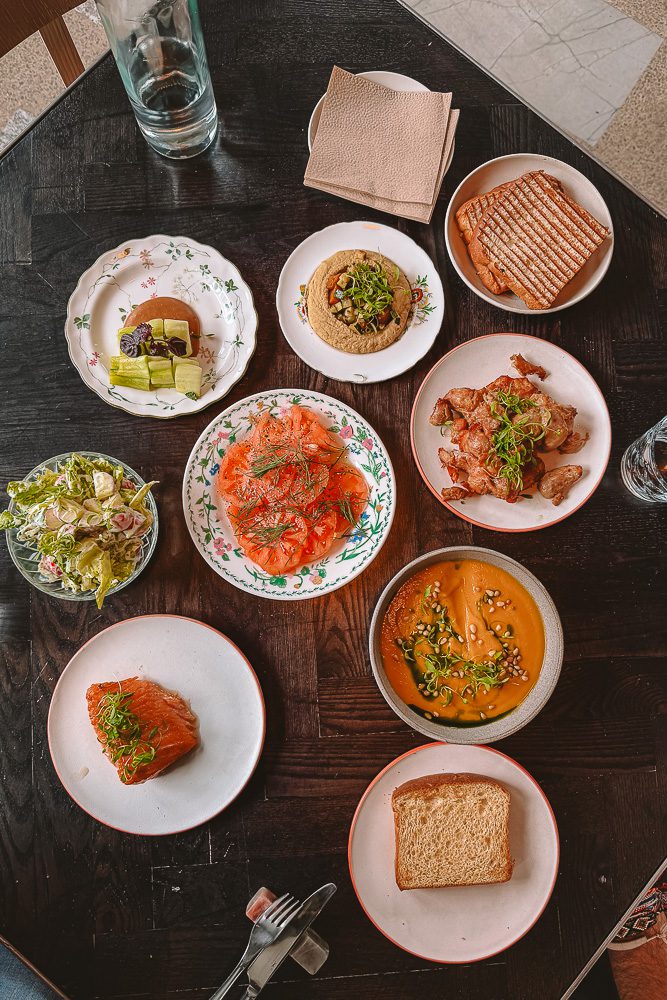
One of the best things to do in Vilnius is definitely eat! I couldn’t believe how many incredible food options there were, from cosy cafés and relaxed lunch spots to creative fusion and fine dining. The city’s food scene is surprisingly diverse, and you can find everything from traditional Lithuanian dishes to modern interpretations of the country’s culinary heritage. Here are my favorites in the city:
Fine dining
- Amandus: A stylish fine-dining restaurant offering creative contemporary cuisine inspired by Lithuanian flavours, with beautifully presented seasonal dishes.
- DEMOLOFTAS: A creative loft in Naujamiestis that transforms from a daytime café and bistro into DEMO Restoranas at night, offering experimental tasting menus built around local ingredients.
- Ertlio Namas: A refined restaurant celebrating Lithuania’s culinary heritage through historical recipes reinterpreted with modern techniques and local ingredients.
- Motíf: A sophisticated spot on Didžioji Street serving contemporary, shareable dishes alongside creative cocktails in a stylish, cosmopolitan setting.
- Nineteen18: An intimate fine-dining restaurant focused on seasonal Lithuanian ingredients, with a creative tasting menu inspired by the country’s landscapes and culinary traditions.
- Saint-Malo: A cosy French-inspired seafood restaurant specialising in fresh fish, oysters and other Atlantic flavours, paired with a carefully curated wine list.
Lunch & coffee
- Augustas & Barbora Love Story Café: A charming café in the heart of Vilnius, known for its cosy atmosphere, beautifully presented brunch dishes and homemade cakes, making it a lovely spot for breakfast or a relaxed coffee break.
- Etno Dvaras: A great place to try traditional Lithuanian cuisine, with certified Heritage dishes such as cepelinai, šaltibarščiai and hearty meat dishes in a rustic setting.
- Italala: A colourful specialty coffee shop on Vokiečių Street known for carefully brewed coffee, excellent homemade pastries and a bright, lively atmosphere!
- Kiras: A laid-back spot for artisan pastries, creative sandwiches and vegetarian and vegan options, perfect for breakfast, brunch or a light lunch.
- Pacai Café: A stylish café in the Old Town combining French-inspired pastries with excellent specialty coffee, perfect for breakfast or an afternoon treat.
What to eat
If you want to discover traditional Lithuanian cuisine, there are a few dishes you should definitely try. Šaltibarščiai is probably the most iconic Lithuanian dish. This bright-pink cold beetroot soup combines kefir, cucumber, dill and egg. It is traditionally served with hot potatoes on the side. The combination of the cold soup and warm potatoes might sound unusual, but I actually loved it!
You can also look out for cepelinai, large potato dumplings usually filled with meat, curd cheese or mushrooms, kugelis, a traditional baked potato dish, or kepta duona, crispy fried rye bread often served with garlic and cheese sauce.




Where to stay in Vilnius
During my three visits to Vilnius, I stayed at Pacai Hotel, Neringa Hotel and Novotel Vilnius Center. My favourite was Pacai, but each one offers a slightly different experience.
- Pacai Hotel: My favourite. Housed in a beautifully restored 17th-century Baroque palace, Pacai sits right in the heart of the Old Town. I loved the mix of historic architecture, original frescoes and contemporary design.
- Neringa Hotel: Located on Gedimino Avenue, this elegant, Nordic-inspired hotel is a great option if you prefer a livelier location, with cafés, restaurants and the Old Town all within walking distance. Its historic restaurant and bar have been a cultural landmark in Vilnius since the 1960s.
- Novotel Vilnius Center: A more modern and practical option, with a very convenient central location on Gedimino Avenue. It’s a good choice if you mainly want a comfortable base from which to explore the city.
Whichever you choose, I recommend staying as centrally as possible: Vilnius is wonderfully walkable, and most of the main sights can easily be reached on foot.


My Photography Tips for Vilnius
If you’re visiting Vilnius with your camera, timing makes a big difference. Except for a few spots, I actually found the late-afternoon light to be the most beautiful, especially on the historic streets and façades. For the prettiest light, I’d save the Old Town for later in the day rather than trying to photograph everything first thing in the morning.
Best for sunrise:
- Cathedral Square
- Gate of Dawn
For the prettiest late-afternoon light:
- Old Town
- St Anne’s
- Pilies Street
- Stiklių Street
Best for sunset:
- Gediminas Tower
- Three Crosses Hill
After visiting Vilnius three times, in winter, spring and summer, I can honestly say that this is one of the most underrated capitals in Europe.
From its beautiful Baroque churches and Italian influences to colourful Užupis, hidden courtyards, excellent food and surprisingly diverse experiences, there is so much more to Vilnius than I expected. It’s walkable, beautiful, affordable and full of character, without feeling as overwhelmed by tourism as some of Europe’s better-known capitals. And whether you visit for the Christmas magic, spring blossoms or long summer days, the city has something different to offer in every season.
So if you’re planning a trip to the Baltics, don’t just stop in Riga or Tallinn, give Vilnius a few days. I have a feeling it might surprise you too!
I’ve put everything that I thought was necessary for you to plan your best trip there. But if you need, feel free to reach out with any questions! And don’t forget to tag me in your stories and posts on Instagram if this article inspires you!
With love,
Marina
If you liked this post, pin it for later!


💡 Did you know that…
By purchasing through my links, you support me at no additional cost.
Thank you for your support. ♥️
